The dialogue with our stakeholder
Double materiality analysis and structured stakeholder engagement
In line with the Corporate Sustainability Reporting Directive (EU Directive 2022/2464 – CSRD) and consistent with the principles set out in European Sustainability Reporting Standard 1 (ESRS 1) and ESRS 2, the Mondadori Group has carried out a structured update of its materiality assessment process, adopting the principle of double materiality.
This methodology makes it possible to identify, in an integrated way:
- on the one hand, the issues that generate significant – positive or negative, actual or potential – impacts on the environment, governance, people and human rights (impact materiality);
- on the other hand, the issues that significantly affect the financial performance, position or development of the organization (financial materiality).
The entire process is structured in five methodological phases:
- Mapping of relevant stakeholders, both internal and external, based on their strategic influence and exposure to the impacts generated by the Group’s activities (e.g. readers, customers, employees, teachers);
- Identification of actual and potential impacts across the value chain, taking into account environmental, social, governance and human rights aspects;
- Multi-stakeholder engagement, through a quantitative survey, to assess the significance of material issues;
- Evaluation and prioritization of issues based on the integrated analysis of the feedback collected and internal assessments (management, committees);
- Final approval and validation of material topics, incorporated into the Sustainability Report in accordance with ESRS requirements.
A participatory and listening-based process
During 2024, the engagement activity included the distribution of an online questionnaire to a broad range of stakeholders – from readers and customers to teachers and employees – collecting over 3,400 responses in total.
The process benefitted from the Group’s consolidated relationships with its key stakeholders, especially in the fields of education and culture, where Mondadori plays a prominent social and editorial role. The data collected were complemented by the assessments of the Management Committee, ensuring a transversal and strategic interpretation of the results.
The results of the double materiality analysis
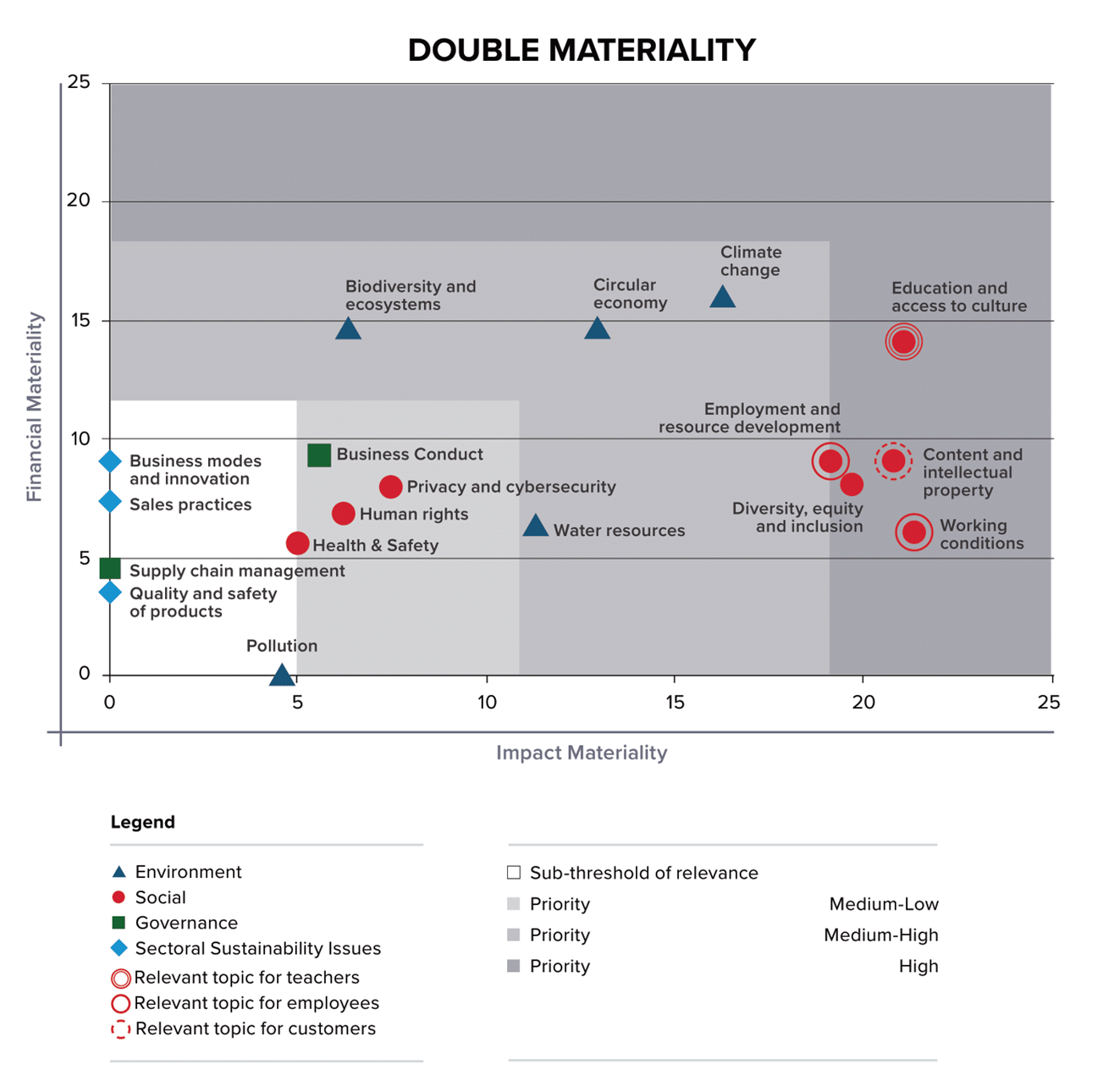
The resulting double materiality matrix graphically illustrates the relevance of topics across two dimensions:
- Horizontal axis: significance of the impacts generated (impact materiality);
- Vertical axis: financial relevance for the organization (financial materiality).
Among the areas of greatest strategic importance identified are:
- Education and access to culture, content and intellectual property, working conditions, diversity, equity and inclusion, and employment and human capital development;
- On the environmental side: climate change, circular economy, biodiversity and ecosystems;
- In the area of ethics and governance: human rights, health and safety, privacy and cybersecurity, and business conduct.
Material topics for the Group